
Our free crypto liquidation calculator helps cryptocurrency traders estimate the liquidation price of leveraged positions before entering a trade. Calculate approximate liquidation levels for Bitcoin (BTC), Ethereum (ETH) and other cryptocurrencies using your entry price, position size, leverage, maintenance margin and estimated closing fees.
The crypto liquidation calculator supports both Buy / Long and Sell / Short positions for linear USDT-margined perpetual futures using an isolated margin model. Whether you are trading with 5×, 10×, 20× or higher leverage, understanding your estimated liquidation threshold can help you evaluate the risks associated with leveraged cryptocurrency trading.
Liquidation occurs when a leveraged position no longer meets the applicable margin requirements under an exchange’s liquidation rules. The liquidation price depends on several factors, including position direction, entry price, leverage, allocated margin, maintenance margin requirements and applicable fees.
Our calculator allows you to enter additional isolated margin to explore how allocating more collateral may affect the estimated liquidation price. It also displays the approximate distance between your entry price and the calculated liquidation threshold, helping you better understand your position’s exposure to adverse market movements.
Unlike a simple leverage calculator, this tool includes user-entered maintenance margin and closing fee assumptions when estimating liquidation levels. However, actual exchange liquidation calculations may also depend on risk tiers, mark prices, funding payments, liquidation fees and other exchange-specific rules.
All calculations are educational estimates based on user-entered information. The calculator does not retrieve live market prices or guarantee exact liquidation levels. It does not support cross margin, portfolio margin or exchange-traded futures. Always verify the applicable liquidation and margin rules directly with your cryptocurrency exchange before opening a leveraged position.
FREE INTERACTIVE CRYPTO RISK TOOL
Crypto Liquidation Calculator
Estimate isolated-margin liquidation levels for linear USDT-margined perpetual futures. Supports Long and Short trades. No live exchange data.
Estimated results
Linear isolated-margin model. A venue's actual liquidation engine may produce a different threshold.
Educational estimate — not a live liquidation trigger or exchange quote. This simplified model assumes one isolated linear USDT position with a fixed maintenance tier, mark-price-based maintenance, estimated close fee and user-entered adjustments. It does not model cross/portfolio margin, inverse contracts, multiple positions, exchange risk-tier transitions, hedges, account equity, auto-margin additions or all funding and fee mechanics. Liquidation is typically assessed using the exchange's mark price, not necessarily last traded price. Liquidation can occur earlier than this estimate. Check your exchange's position screen before trading; losses may be substantial.
How to Use the Crypto Liquidation Calculator
Our free crypto liquidation calculator helps traders estimate the price at which an isolated-margin cryptocurrency futures position may become subject to liquidation.
The calculator supports Buy / Long and Sell / Short positions for linear USDT-margined perpetual futures. It uses your entry price, position size, leverage, maintenance margin rate, estimated closing fee rate and any additional isolated margin.
The result is an educational estimate, not a guaranteed exchange liquidation price.
Step 1: Select Your Cryptocurrency and Trade Direction
Enter the cryptocurrency symbol, such as BTC or ETH, and select your trade direction.
Buy / Long: You expect the cryptocurrency price to increase. A sufficiently large price decline can bring your position toward liquidation.
Sell / Short: You expect the cryptocurrency price to decrease. A sufficiently large price increase can bring your position toward liquidation.
Selecting the correct trade direction is essential because LONG and SHORT liquidation levels are calculated differently.
Step 2: Enter Your Position Details
Enter the entry price, position size and leverage for your proposed trade.
For example, consider a Bitcoin LONG position:
- Asset: BTC
- Trade Direction: Buy / Long
- Entry Price: 50,000 USDT
- Position Value: 10,000 USDT
- Selected Leverage: 10×
With an entry price of 50,000 USDT and a position value of 10,000 USDT:
Position Quantity = Position Value / Entry Price
Position Quantity = 10,000 / 50,000
Position Quantity = 0.20 BTC
The estimated initial margin is:
Initial Margin = Position Value / Leverage
Initial Margin = 10,000 / 10
Initial Margin = 1,000 USDT
This calculation assumes a simplified isolated-margin position and excludes additional exchange-specific adjustments.
Step 3: Enter the Maintenance Margin Rate
Maintenance margin is the minimum collateral requirement associated with keeping a leveraged position open.
In the calculator, enter the maintenance margin rate as a percentage.
For our BTC example, assume:
Maintenance Margin Rate = 0.50%
The actual maintenance margin requirement depends on the exchange, trading instrument, position size and applicable risk tier.
Some exchanges calculate maintenance margin using tiered rates and deductions rather than one fixed percentage.
The maintenance margin rate in this example is illustrative and should not be treated as a live exchange rate.
Step 4: Enter the Estimated Closing Fee
Closing a leveraged position may involve trading fees and exchange-specific liquidation charges.
Our calculator provides an input for an estimated closing fee rate.
For this example:
Estimated Closing Fee Rate = 0.05%
This is an assumed calculation input, not a guaranteed fee charged by your exchange.
The calculator uses a simplified fee allowance. Actual closing and liquidation fees may be calculated differently.
Step 5: Calculate the Estimated LONG Liquidation Price
For a linear USDT-margined LONG position with no extra margin, our simplified model can be expressed as:
LONG Liquidation Price = Entry Price × (1 − 1 / Leverage) / (1 − Maintenance Margin Rate − Closing Fee Rate)
The margin and fee rates must be expressed as decimal values.
For our example:
- Entry Price: 50,000 USDT
- Leverage: 10×
- Maintenance Margin Rate: 0.005
- Closing Fee Rate: 0.0005
- Extra Margin: 0 USDT
LONG Liquidation Price = 50,000 × (1 − 0.10) / (1 − 0.005 − 0.0005)
Estimated LONG Liquidation Price ≈ 45,248.87 USDT
This means the simplified model estimates a liquidation threshold below the 50,000 USDT entry price.
Actual liquidation may occur at a different level because of exchange rules, mark price calculations, risk tiers, funding adjustments and fees.
Step 6: Calculate the Distance to Liquidation
The distance between your entry price and estimated liquidation price helps you understand the approximate adverse price movement represented by the calculation.
For a LONG position:
Distance to Liquidation (%) = (Entry Price − Liquidation Price) / Entry Price × 100
Using our BTC example:
Distance = (50,000 − 45,248.87) / 50,000 × 100
Estimated Distance to Liquidation ≈ 9.50%
This is a percentage price distance, not the probability of liquidation.
A larger distance does not guarantee that a position is safe, especially during volatile markets.
Step 7: Estimate the SHORT Liquidation Price
For SHORT positions, liquidation risk generally increases when the cryptocurrency price rises.
Under the same simplified assumptions, and with no extra margin:
SHORT Liquidation Price = Entry Price × (1 + 1 / Leverage) / (1 + Maintenance Margin Rate + Closing Fee Rate)
Consider a BTC SHORT position with:
- Entry Price: 50,000 USDT
- Position Value: 10,000 USDT
- Leverage: 10×
- Maintenance Margin Rate: 0.50%
- Closing Fee Rate: 0.05%
- Extra Margin: 0 USDT
SHORT Liquidation Price = 50,000 × 1.10 / 1.0055
Estimated SHORT Liquidation Price ≈ 54,699.15 USDT
Under these illustrative assumptions, the estimated liquidation level is above the entry price.
This calculation is not intended to reproduce the exact liquidation engine of any particular exchange.
Step 8: Understand How Leverage Changes Liquidation Risk
Leverage affects the amount of initial collateral allocated relative to the position’s notional exposure.
For the same position value, higher leverage generally reduces initial margin and brings the estimated liquidation threshold closer to the entry price.
For example, a trader opening a 10,000 USDT position would allocate approximately:
- At 5× leverage: 2,000 USDT initial margin.
- At 10× leverage: 1,000 USDT initial margin.
- At 20× leverage: 500 USDT initial margin.
The notional position value remains 10,000 USDT in all three scenarios.
Higher leverage does not make the trade more profitable by itself. It increases the size of the exposure relative to allocated collateral and can substantially increase liquidation risk.
Step 9: Understand Additional Isolated Margin
Some cryptocurrency exchanges allow traders to add more collateral to an existing isolated-margin position.
Our calculator provides an Extra Margin input so you can explore how additional allocated margin changes the estimated liquidation threshold.
For a LONG position, adding margin generally moves the estimated liquidation price lower.
For a SHORT position, adding margin generally moves the estimated liquidation price higher.
This can increase the distance between the entry price and the estimated liquidation threshold.
However, additional collateral does not eliminate market risk or guarantee that liquidation will be avoided.
Step 10: Understand Mark Price and Actual Exchange Liquidation
Cryptocurrency exchanges frequently use a Mark Price rather than the last traded price to determine liquidation conditions.
Mark Price is an exchange-calculated reference price designed to support margin and unrealized profit-and-loss calculations.
As a result, the market price displayed on a standard candlestick chart may differ from the price used by the exchange’s liquidation system.
Actual liquidation calculations may also depend on:
- Maintenance margin tiers and deductions.
- Funding payments and accumulated fees.
- Exchange-specific closing fee estimates.
- Position changes and additional collateral.
- The selected margin mode.
- Mark Price and exchange risk-engine rules.
Our calculator does not retrieve live Mark Prices or automatically synchronize exchange margin requirements.
Always consult the liquidation price displayed by your exchange for your actual position.
Step 11: Understand the Difference Between Isolated and Cross Margin
Isolated Margin: A defined amount of collateral is allocated to an individual position, subject to the exchange’s rules.
Cross Margin: Available account collateral may support multiple positions, and account-wide equity can affect liquidation risk.
Our crypto liquidation calculator currently supports a simplified isolated-margin model for linear USDT-margined contracts.
It does not calculate cross-margin, portfolio-margin or exchange-traded futures liquidation thresholds.
Using its results for unsupported margin modes could produce misleading estimates.
Important Considerations When Trading Leveraged Crypto
Liquidation is a significant risk associated with leveraged cryptocurrency trading.
Even relatively small adverse market movements can cause substantial losses when leverage is high.
A liquidation price estimate should not be used as a guaranteed stop-loss level or as proof that an exchange will close a position at a particular price.
Stop-loss orders may also be subject to slippage, execution conditions and price gaps.
Before entering a leveraged trade, verify the exchange’s margin specifications, liquidation rules, fees, mark price methodology and current risk limits.
Our free crypto liquidation calculator is an educational risk-planning tool. Its results are approximate and should not be treated as personalized investment advice.
Crypto Liquidation Calculator Examples: BTC Long and Short
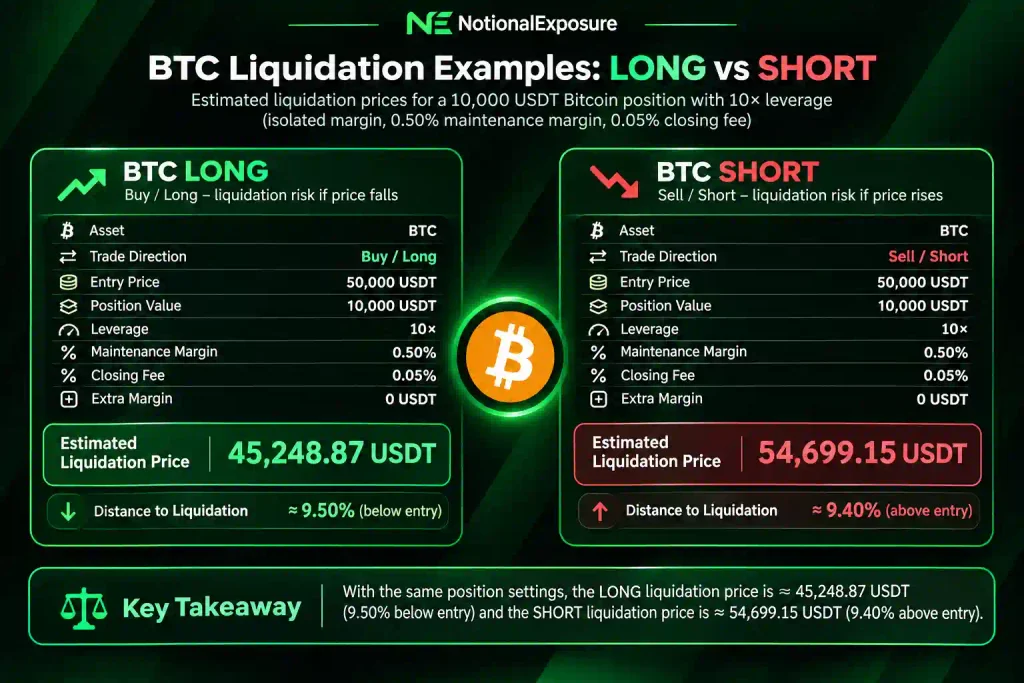
BTC LONG vs SHORT liquidation price comparison using 10× leverage, 0.50% maintenance margin and 0.05% estimated closing fee. Illustrative calculations only.
Understanding the difference between LONG and SHORT liquidation prices is important when trading leveraged cryptocurrency futures.
The following examples demonstrate how our free crypto liquidation calculator estimates liquidation thresholds for Bitcoin positions using a simplified isolated-margin model.
All values are illustrative and do not represent live exchange liquidation levels.
Example 1: Bitcoin LONG Liquidation Price with 10× Leverage
Suppose a trader opens a Bitcoin LONG position expecting BTC to increase in value.
Trade Settings:
- Asset: BTC
- Trade Direction: Buy / Long
- Entry Price: 50,000 USDT
- Position Value: 10,000 USDT
- Leverage: 10×
- Maintenance Margin Rate: 0.50%
- Estimated Closing Fee Rate: 0.05%
- Extra Isolated Margin: 0 USDT
Step 1: Calculate Initial Margin
Initial Margin = Position Value / Leverage
Initial Margin = 10,000 / 10
Initial Margin = 1,000 USDT
Step 2: Calculate Position Quantity
Position Quantity = Position Value / Entry Price
Position Quantity = 10,000 / 50,000
Position Quantity = 0.20 BTC
Step 3: Estimate the LONG Liquidation Price
Using the calculator’s simplified model:
LONG Liquidation Price = Entry Price × (1 − 1 / Leverage) / (1 − Maintenance Margin Rate − Closing Fee Rate)
LONG Liquidation Price = 50,000 × 0.90 / 0.9945
Estimated LONG Liquidation Price ≈ 45,248.87 USDT
Step 4: Calculate Distance to Liquidation
Distance = (50,000 − 45,248.87) / 50,000 × 100
Distance to Liquidation ≈ 9.50%
What Does This LONG Example Show?
A trader opening a 10,000 USDT Bitcoin LONG position with 10× leverage allocates approximately 1,000 USDT in initial margin.
Under the simplified model, the estimated liquidation price is approximately 45,248.87 USDT.
This represents a price decline of approximately 9.50% from the entry price.
Actual liquidation can occur at a different price depending on exchange rules, maintenance margin tiers, Mark Price, fees and funding adjustments.
Example 2: Bitcoin SHORT Liquidation Price with 10× Leverage
Now consider a trader opening a Bitcoin SHORT position, expecting BTC to decrease in value.
Trade Settings:
- Asset: BTC
- Trade Direction: Sell / Short
- Entry Price: 50,000 USDT
- Position Value: 10,000 USDT
- Leverage: 10×
- Maintenance Margin Rate: 0.50%
- Estimated Closing Fee Rate: 0.05%
- Extra Isolated Margin: 0 USDT
Step 1: Calculate Initial Margin
Initial Margin = 10,000 / 10
Initial Margin = 1,000 USDT
Step 2: Calculate Position Quantity
Position Quantity = 10,000 / 50,000
Position Quantity = 0.20 BTC
Step 3: Estimate the SHORT Liquidation Price
Using the simplified SHORT formula:
SHORT Liquidation Price = Entry Price × (1 + 1 / Leverage) / (1 + Maintenance Margin Rate + Closing Fee Rate)
SHORT Liquidation Price = 50,000 × 1.10 / 1.0055
Estimated SHORT Liquidation Price ≈ 54,699.15 USDT
Step 4: Calculate Distance to Liquidation
Distance = (54,699.15 − 50,000) / 50,000 × 100
Distance to Liquidation ≈ 9.40%
What Does This SHORT Example Show?
For a SHORT position, rising cryptocurrency prices increase liquidation risk.
Under these illustrative settings, the estimated liquidation price is approximately 54,699.15 USDT, or 9.40% above the entry price.
Even though the LONG and SHORT positions have identical entry prices, position values and leverage, their estimated liquidation distances differ slightly because the simplified formulas account for maintenance margin and closing fee assumptions differently.
Comparing LONG and SHORT Liquidation Prices
Using the same BTC position settings:
- LONG: Estimated liquidation at 45,248.87 USDT, approximately 9.50% below entry.
- SHORT: Estimated liquidation at 54,699.15 USDT, approximately 9.40% above entry.
- Initial Margin: 1,000 USDT for either position.
- Position Value: 10,000 USDT.
These examples illustrate how trade direction changes the estimated liquidation threshold.
The calculated values should not replace the liquidation price displayed by your exchange. Always verify the applicable maintenance margin requirements, Mark Price rules and liquidation fees before opening a leveraged position.
Crypto Liquidation Calculator — Frequently Asked Questions
What is a crypto liquidation calculator?
A crypto liquidation calculator is a tool that estimates the price at which a leveraged cryptocurrency position may become subject to liquidation.
Our free crypto liquidation calculator supports LONG and SHORT positions for linear USDT-margined perpetual futures using a simplified isolated-margin model.
It considers the entry price, position value, leverage, maintenance margin rate, estimated closing fees and any additional isolated margin entered by the user.
The results are educational estimates and may differ from the liquidation prices calculated by cryptocurrency exchanges.
How do I calculate my Bitcoin liquidation price?
To estimate your Bitcoin liquidation price, enter your trade direction, entry price, position size, leverage and the applicable margin assumptions.
For example, consider a BTC LONG position with the following settings:
- Entry Price: 50,000 USDT
- Position Value: 10,000 USDT
- Leverage: 10×
- Maintenance Margin Rate: 0.50%
- Estimated Closing Fee: 0.05%
- Extra Margin: 0 USDT
Using our simplified isolated-margin model:
Estimated LONG Liquidation Price ≈ 45,248.87 USDT
The exact exchange liquidation price may differ because of maintenance margin tiers, mark price rules, fees and other adjustments.
What is the difference between LONG and SHORT liquidation?
LONG and SHORT positions face liquidation risk in opposite price directions.
LONG positions: Liquidation risk generally increases when the cryptocurrency price falls.
SHORT positions: Liquidation risk generally increases when the cryptocurrency price rises.
For example, using an entry price of 50,000 USDT, 10× leverage and the same illustrative margin assumptions:
- LONG estimated liquidation price: 45,248.87 USDT.
- SHORT estimated liquidation price: 54,699.15 USDT.
Both results are approximations based on the calculator’s stated assumptions.
Does higher leverage increase liquidation risk?
Yes. For the same notional position size and otherwise unchanged conditions, higher leverage generally reduces the initial collateral allocated and brings the estimated liquidation price closer to the entry price.
For a 10,000 USDT position:
- 5× leverage requires approximately 2,000 USDT in simplified initial margin.
- 10× leverage requires approximately 1,000 USDT.
- 20× leverage requires approximately 500 USDT.
Higher leverage increases exposure relative to allocated margin and can make positions more vulnerable to adverse price movements.
Can I move my liquidation price by adding margin?
Adding collateral to an isolated-margin position can change its estimated liquidation threshold.
For a LONG position, additional margin generally moves the liquidation price lower.
For a SHORT position, additional margin generally moves the liquidation price higher.
Our calculator includes an Extra Margin field to estimate the effect of additional isolated collateral.
However, adding margin also increases the amount of capital exposed to potential trading losses. It does not guarantee that liquidation will be avoided.
What is maintenance margin in cryptocurrency trading?
Maintenance margin is the minimum collateral requirement associated with keeping a leveraged position open under the exchange’s applicable rules.
If the position no longer satisfies the relevant margin requirements, it may become subject to liquidation.
Cryptocurrency exchanges may use different maintenance margin rates depending on the trading pair, position size and risk tier.
Our calculator allows users to enter an assumed maintenance margin rate, but it does not automatically retrieve live exchange margin schedules.
Why is my exchange liquidation price different from the calculator?
A cryptocurrency exchange may use more detailed liquidation calculations than a general-purpose online calculator.
Differences can result from:
- Mark Price rather than the last traded price.
- Maintenance margin tiers and deductions.
- Funding payments and accrued trading fees.
- Estimated liquidation or closing fees.
- Additional collateral and position adjustments.
- Exchange-specific risk management rules.
Our calculator uses a simplified model for isolated linear USDT-margined positions.
For an actual open trade, consult the liquidation information displayed by your exchange.
Does the crypto liquidation calculator support cross margin?
No. Our calculator currently estimates liquidation prices for isolated-margin positions in linear USDT-margined perpetual futures.
Cross margin can use available account collateral to support multiple positions, meaning liquidation depends on account-wide equity and other exposures.
The simplified isolated-margin calculation is not suitable for determining exact cross-margin or portfolio-margin liquidation thresholds.
The tool also does not calculate liquidation prices for exchange-traded futures or inverse coin-margined cryptocurrency contracts.
Always select the appropriate margin model and verify your position’s liquidation conditions directly with your trading platform.
Explore More Free Crypto Trading Calculators
Understanding liquidation risk is only one part of managing leveraged cryptocurrency positions. Explore our other free trading calculators to estimate position sizes, required margin, potential profits and trading risks.
Use our Crypto Position Size Calculator to estimate position quantity and risk based on your account balance, entry price and stop-loss level.
Our Crypto P&L Calculator helps you estimate potential profits, losses, trading fees and return on margin for spot and USDT-margined futures positions.
You can also use our Margin Calculator to calculate estimated initial margin, leverage and notional exposure for cryptocurrency, Forex and exchange-traded futures.
For additional risk management, try our Risk Reward Calculator to compare potential gains and losses before opening a trade.
Browse all available tools in our Trading Calculators directory.
For an official explanation of cryptocurrency liquidation rules, read Bybit’s guide to the liquidation process. The exchange explains how Mark Price, maintenance margin requirements and risk limits affect liquidation for leveraged futures positions.
Understanding these exchange-specific rules is important when comparing estimated liquidation prices with actual trading conditions. Our crypto liquidation calculator uses a simplified educational model and does not reproduce the complete liquidation engine of any exchange.
Always verify your actual liquidation price, maintenance margin requirements and applicable fees directly with your trading platform.