
Our free margin calculator helps traders estimate the initial margin required to open leveraged positions in cryptocurrency, Forex and exchange-traded futures markets. Calculate margin requirements, notional exposure, effective exposure-to-margin ratios and estimated available capital before entering a trade.
The margin calculator supports three different trading markets. For cryptocurrency trading, estimate margin based on position value and selected leverage. For Forex trading, calculate required margin using position size in lots, contract size, exchange rate and account leverage. For futures trading, estimate margin requirements using the number of contracts and the broker’s margin requirement per contract.
Understanding trading margin is essential for managing market exposure and avoiding positions that require more collateral than your available trading balance. The calculator also helps you compare required margin with your entered account balance and estimate how much capital remains after allocating initial margin.
Unlike profit and loss calculators, a margin calculator focuses on the collateral required to support a position rather than predicting its profitability. Margin requirements can change due to market volatility, exchange regulations and broker policies. Initial margin is not a maximum-loss limit, and leveraged trading can result in substantial losses.
Our free online margin calculator uses user-entered prices, leverage settings and broker requirements. It does not retrieve live exchange rates, guarantee trading eligibility or calculate liquidation prices. Always verify the latest contract specifications and margin requirements with your broker before placing a trade.
FREE INTERACTIVE TRADING TOOL
Trading Margin Calculator
Estimate initial margin and market exposure for crypto, forex and exchange-traded futures. No live quotes or broker margin feeds.
Results
Results are educational estimates based on the information you enter.
Educational estimates only; not investment advice. Initial margin is collateral, not a maximum-loss limit. The calculator does not fetch live prices, leverage limits, broker margin schedules, maintenance margin, liquidation thresholds, unrealized P&L, commissions or currency rates. Actual available funds, margin calls and liquidation risk depend on the exchange or broker, collateral valuation, other positions, market conditions and applicable rules. Enter current contract specifications and conversion rates before trading.
How to Use the Margin Calculator
Our free margin calculator helps traders estimate the capital required to open leveraged positions in cryptocurrency, Forex and exchange-traded futures markets. Understanding margin requirements is essential for managing trading exposure, comparing leverage and planning capital allocation.
Margin is the collateral required to support a trading position. It is different from the total market value of the position and should never be treated as the maximum amount a trader can lose.
The calculation method depends on the financial market. Cryptocurrency and Forex margin commonly depend on position value and leverage, while exchange-traded futures use contract-specific margin requirements set by brokers and clearing arrangements.
Follow the steps below to calculate trading margin for your preferred market.
Step 1: Select Your Trading Market
Start by selecting the market you want to trade from the Market Type dropdown.
The margin calculator supports three modes:
Crypto — USDT-margined: Calculate estimated initial margin using the position’s notional value and selected leverage. This mode is intended for linear USDT-margined cryptocurrency positions.
Forex — USD account: Estimate the margin required for a Forex position using lot size, contract size, currency-pair price, quote-to-USD conversion and leverage.
Futures — exchange-traded (USD): Calculate estimated margin for standardized futures contracts using the number of contracts and the margin requirement entered for each contract.
Select the correct market before entering your position details because each mode uses different calculation inputs.
Step 2: Calculate Crypto Margin
Cryptocurrency margin trading allows traders to control a position larger than the amount of initial collateral allocated.
For a simplified linear USDT-margined position, the estimated initial margin is calculated using:
Initial Margin = Notional Position Value / Selected Leverage
For example, suppose a trader wants to open a Bitcoin futures position with a notional value of 10,000 USDT using 10× leverage.
Initial Margin = 10,000 / 10
Required Initial Margin = 1,000 USDT
The trader controls a position worth 10,000 USDT while allocating an estimated 1,000 USDT as initial margin.
This calculation excludes additional collateral requirements, maintenance margin, fees and exchange-specific margin rules.
Higher leverage generally reduces the initial margin required for the same notional position, but increases market exposure relative to the allocated collateral.
Step 3: Use the Crypto Position Sizing Options
Our margin calculator supports two approaches to crypto position sizing.
By Notional Position Value: Enter the total market value of the position and the selected leverage. The calculator estimates the required initial margin.
By Margin / Capital: Enter the amount of margin you plan to allocate and the selected leverage. The calculator estimates the corresponding notional position value.
For the second method, use:
Notional Position Value = Allocated Margin × Leverage
For example:
Allocated Margin = 500 USDT
Leverage = 20×
Notional Position Value = 500 × 20
Estimated Position Value = 10,000 USDT
This does not mean the trader has earned 10,000 USDT or that the position is protected from liquidation. It represents the theoretical notional exposure under the selected leverage.
Step 4: Calculate Forex Margin
Forex margin calculations depend on the size of the currency position, the exchange rate and the leverage available for the instrument.
Our Forex mode uses an account denominated in USD.
First, calculate the number of base currency units:
Base Currency Units = Number of Lots × Units per Lot
For example, consider a EUR/USD position with the following details:
- Currency Pair: EUR/USD
- Position Size: 0.50 lots
- Contract Size: 100,000 EUR per standard lot
- EUR/USD Price: 1.1000
- Account Leverage: 1:30
- Account Currency: USD
Base Currency Units = 0.50 × 100,000
Position Size = 50,000 EUR
Next, convert the position value into the quote currency:
Position Value = 50,000 × 1.1000
Notional Exposure = 55,000 USD
Then calculate the estimated initial margin:
Forex Margin = USD Notional Exposure / Leverage
Forex Margin = 55,000 / 30
Required Initial Margin ≈ 1,833.33 USD
This represents approximately 3.33% of the position’s notional value.
Broker requirements can differ by currency pair, account classification, jurisdiction and trading conditions.
Step 5: Understand Currency Conversion in Forex
Forex pairs are quoted using two currencies: a base currency and a quote currency.
For EUR/USD, the base currency is EUR and the quote currency is USD.
If your account is denominated in USD and the quote currency is also USD, the quote-to-USD conversion factor is 1.
For other currency pairs, you may need to convert the position’s quote-currency value into USD.
Our margin calculator provides an input labeled USD per 1 quote currency unit.
For example, a USD/JPY position is quoted in Japanese yen. To express its notional value in a USD account, the resulting JPY amount must be multiplied by the appropriate JPY-to-USD conversion rate.
USD Notional Exposure = Base Units × Pair Price × Quote-to-USD Conversion Factor
The calculator does not automatically retrieve live exchange rates. Always use an appropriate current conversion rate and confirm the broker’s actual margin calculation method.
Step 6: Calculate Futures Margin
Exchange-traded futures use standardized contracts with specific multipliers, tick sizes and margin requirements.
Unlike the simplified crypto and Forex examples, futures margin cannot reliably be determined by choosing an arbitrary leverage ratio.
Our futures margin calculator supports contracts including:
- ES — E-mini S&P 500
- MES — Micro E-mini S&P 500
- NQ — E-mini Nasdaq-100
- MNQ — Micro E-mini Nasdaq-100
- CL — WTI Crude Oil
- MCL — Micro WTI Crude Oil
- GC — Gold Futures
- MGC — Micro Gold Futures
You can also enter custom USD-denominated contract specifications.
For futures positions, estimated total margin is calculated using:
Total Margin = Number of Contracts × Broker Margin per Contract
For example, assume a trader wants to open two MES futures contracts and the applicable broker margin requirement is 2,000 USD per contract.
Total Margin = 2 × 2,000
Estimated Total Margin = 4,000 USD
The 2,000 USD figure is illustrative, not a live broker requirement.
Actual initial and maintenance margin requirements can change with the broker, clearing arrangements, contract and market volatility.
Step 7: Understand Futures Notional Exposure
Futures margin is not the same as the notional value of a futures position.
For a contract quoted in index points or price units, an illustrative notional exposure calculation is:
Notional Exposure = Reference Price × Contract Multiplier × Number of Contracts
Consider two MES contracts with the following specifications:
Reference Price = 6,000
Contract Multiplier = $5 per index point
Number of Contracts = 2
Notional Exposure = 6,000 × $5 × 2
Total Notional Exposure = 60,000 USD
If the estimated total broker margin is 4,000 USD:
Exposure / Margin Ratio = 60,000 / 4,000 = 15×
This 15× figure describes the ratio between notional exposure and estimated margin. It is not a selectable exchange leverage setting.
A position can lose substantially more than its initial margin, particularly during sharp adverse market movements.
Step 8: Calculate Margin Utilization
Margin utilization helps traders estimate how much of their entered account balance would be allocated to the required initial margin.
Margin Utilization (%) = (Estimated Initial Margin / Account Balance) × 100
For example, consider a Forex trading account containing 10,000 USD.
Required Initial Margin = 1,833.33 USD
Account Balance = 10,000 USD
Margin Utilization = (1,833.33 / 10,000) × 100
Estimated Margin Utilization ≈ 18.33%
The calculator also shows an indicative balance remaining after the estimated margin allocation:
Estimated Remaining Balance = Entered Account Balance − Estimated Initial Margin
Estimated Remaining Balance = 10,000 − 1,833.33
Estimated Remaining Balance ≈ 8,166.67 USD
This estimate is not necessarily the broker’s actual free margin or withdrawable balance. Existing positions, unrealized profits and losses, fees and other collateral requirements can affect available trading funds.
Step 9: Understand Margin Percentage and Exposure
Two additional values can help traders interpret their margin requirements.
Margin as % of Exposure = (Estimated Margin / Notional Exposure) × 100
Exposure / Margin Ratio = Notional Exposure / Estimated Margin
For a crypto position with 10,000 USDT of notional exposure and 1,000 USDT of required initial margin:
Margin as % of Exposure = (1,000 / 10,000) × 100
Margin as % of Exposure = 10%
Exposure / Margin Ratio = 10,000 / 1,000
Exposure / Margin Ratio = 10×
For futures, the same ratio can describe the relationship between estimated exposure and broker margin. It should not be interpreted as a guaranteed or fixed leverage setting.
Step 10: Check Whether Your Entered Balance Covers Margin
Before placing a trade, it is useful to compare the estimated initial margin with your entered account balance.
Our margin calculator displays a warning if the estimated margin exceeds the amount entered as the account balance.
For example:
Account Balance = 1,000 USD
Required Initial Margin = 1,833.33 USD
Estimated Remaining Balance = −833.33 USD
In this simplified example, the entered balance is insufficient to cover the estimated initial margin.
However, a positive remaining balance does not guarantee that a broker will approve the trade. Real buying power and margin availability depend on account equity, open positions, collateral rules, maintenance requirements and other conditions.
Important Considerations When Using a Margin Calculator
Margin trading introduces significant financial risks because relatively small market movements can result in substantial gains or losses compared with the collateral deposited.
A lower margin requirement does not make a position safer. Increasing leverage can increase the likelihood of rapid losses, margin calls or liquidation.
Crypto exchanges may use risk tiers and different requirements for various assets and position sizes.
Forex brokers may apply instrument-specific margin percentages, leverage limits and different currency conversion methods.
Futures exchanges and brokers may adjust margin requirements during periods of market volatility or around important events.
Our free margin calculator provides educational estimates based on user-entered details. It does not calculate maintenance margin, margin calls, liquidation prices or guaranteed available buying power.
Always verify current prices, contract specifications, trading conditions and applicable margin requirements with your broker or exchange before opening a leveraged position.
Margin Calculator Examples: Crypto, Forex and Futures
The amount of margin required to open a trading position depends on the market, position size, leverage and broker requirements.
The following three examples demonstrate how our free margin calculator estimates initial margin, notional exposure and account utilization for cryptocurrency, Forex and exchange-traded futures.
All prices and margin requirements are illustrative.
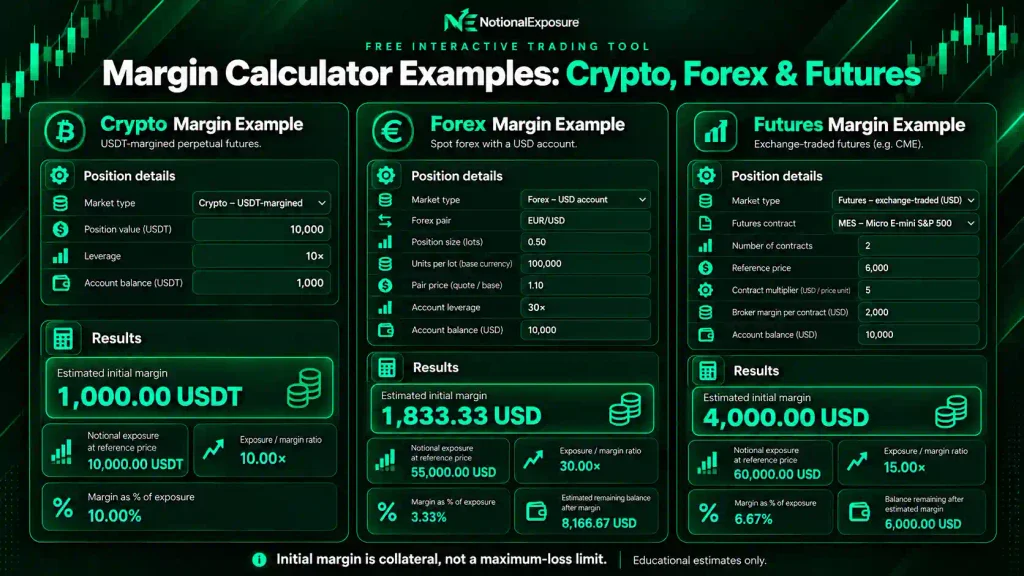
Example 1: Crypto Margin Calculator — BTC Position with 10× Leverage
Suppose a cryptocurrency trader wants to open a linear USDT-margined Bitcoin futures position using the following settings.
Trade Settings:
- Market Type: Crypto — USDT-margined
- Position Value: 10,000 USDT
- Selected Leverage: 10×
- Account Balance: 10,000 USDT
Step 1: Calculate Initial Margin
Initial Margin = Notional Position Value / Leverage
Initial Margin = 10,000 / 10
Required Initial Margin = 1,000 USDT
Step 2: Calculate Margin Utilization
Margin Utilization = (1,000 / 10,000) × 100
Margin Utilization = 10.00%
Step 3: Calculate the Estimated Remaining Balance
Remaining Balance = 10,000 − 1,000
Estimated Remaining Balance = 9,000 USDT
What Does This Example Show?
The trader controls 10,000 USDT of notional exposure while allocating approximately 1,000 USDT in initial margin.
The 10× leverage increases exposure relative to the collateral committed. The 9,000 USDT remaining balance is only a simplified estimate, not guaranteed free collateral or protection against liquidation.
Actual requirements depend on the cryptocurrency exchange, maintenance margin, fees and risk limits.
Example 2: Forex Margin Calculator — EUR/USD with 1:30 Leverage
Consider a Forex trader opening a EUR/USD position in a USD-denominated trading account.
Trade Settings:
- Currency Pair: EUR/USD
- Position Size: 0.50 standard lots
- Contract Size: 100,000 EUR per lot
- EUR/USD Exchange Rate: 1.1000
- Quote-to-USD Conversion Factor: 1
- Account Leverage: 1:30
- Account Balance: 10,000 USD
Step 1: Calculate Position Size
Base Currency Units = Lots × Contract Size
Base Currency Units = 0.50 × 100,000
Position Size = 50,000 EUR
Step 2: Calculate Notional Exposure
USD Notional Exposure = 50,000 × 1.1000
Notional Exposure = 55,000 USD
Step 3: Calculate Required Margin
Required Margin = Notional Exposure / Leverage
Required Margin = 55,000 / 30
Required Initial Margin ≈ 1,833.33 USD
Step 4: Calculate Margin Utilization
Margin Utilization = (1,833.33 / 10,000) × 100
Margin Utilization ≈ 18.33%
Step 5: Calculate the Estimated Remaining Balance
Remaining Balance = 10,000 − 1,833.33
Estimated Remaining Balance ≈ 8,166.67 USD
What Does This Example Show?
A 0.50-lot EUR/USD position at 1.1000 represents approximately 55,000 USD of market exposure.
At 1:30 leverage, the simplified initial margin requirement is approximately 1,833.33 USD.
The actual broker requirement may differ because of applicable leverage limits, instrument-specific margin rates and trading conditions.
Example 3: Futures Margin Calculator — Two MES Contracts
Exchange-traded futures generally use contract-specific margin requirements rather than a freely selected leverage ratio.
Consider a trader opening a position involving two Micro E-mini S&P 500 (MES) futures contracts.
Trade Settings:
- Futures Contract: MES — Micro E-mini S&P 500
- Number of Contracts: 2
- Reference Price: 6,000
- Contract Multiplier: $5 per index point
- Minimum Tick Size: 0.25 points
- Example Broker Margin per Contract: 2,000 USD
- Account Balance: 10,000 USD
Step 1: Calculate Total Notional Exposure
Notional Exposure = Reference Price × Contract Multiplier × Number of Contracts
Notional Exposure = 6,000 × $5 × 2
Total Notional Exposure = 60,000 USD
Step 2: Calculate Required Initial Margin
Initial Margin = Number of Contracts × Broker Margin per Contract
Initial Margin = 2 × 2,000
Required Initial Margin = 4,000 USD
Step 3: Calculate Exposure-to-Margin Ratio
Exposure / Margin = 60,000 / 4,000
Exposure-to-Margin Ratio = 15×
This is a calculated exposure ratio, not a selectable futures leverage setting.
Step 4: Calculate Margin Utilization
Margin Utilization = (4,000 / 10,000) × 100
Margin Utilization = 40.00%
Step 5: Calculate the Estimated Remaining Balance
Remaining Balance = 10,000 − 4,000
Estimated Remaining Balance = 6,000 USD
What Does This Example Show?
The trader controls approximately 60,000 USD in notional MES exposure while allocating an illustrative 4,000 USD in margin.
This example demonstrates why futures traders should distinguish between contract exposure and margin collateral.
The broker margin requirement of 2,000 USD per contract is hypothetical. Actual requirements can change, and losses may exceed the amount of margin deposited.
Comparing Crypto, Forex and Futures Margin
The three examples illustrate different approaches to estimating initial margin:
- Crypto: A 10,000 USDT position at 10× leverage requires approximately 1,000 USDT in simplified initial margin.
- Forex: A 55,000 USD EUR/USD position at 1:30 leverage requires approximately 1,833.33 USD in simplified initial margin.
- Futures: Two MES contracts require 4,000 USD in illustrative margin when the broker requirement is 2,000 USD per contract.
These margin percentages should not be used as direct comparisons of market risk. Different instruments have different volatility, contract structures and collateral rules.
Use our margin calculator to estimate required capital before opening a trade, and independently verify broker requirements, applicable fees and account buying power.
Margin Calculator — Frequently Asked Questions
What is a margin calculator?
A margin calculator is a trading tool that estimates the amount of collateral required to open a leveraged position.
Our free margin calculator supports cryptocurrency, Forex and exchange-traded futures. It helps traders estimate initial margin, notional exposure, margin percentages and the proportion of an entered account balance allocated to margin.
The results are educational estimates based on user-provided values. Actual margin requirements depend on the broker, exchange and financial instrument.
How do you calculate margin in trading?
The margin calculation depends on the market.
For simplified cryptocurrency and Forex positions, required initial margin is generally estimated using:
Required Margin = Notional Position Value / Leverage
For example, a 10,000 USDT crypto position using 10× leverage requires approximately:
10,000 / 10 = 1,000 USDT initial margin
For exchange-traded futures, the calculation instead uses the applicable margin requirement per contract:
Futures Margin = Number of Contracts × Margin per Contract
Always verify the broker’s actual requirements before trading.
How much margin do I need for a Forex trade?
Forex margin depends on the position size, currency exchange rate, account currency and permitted leverage.
For example, a 0.50-lot EUR/USD position at an exchange rate of 1.1000 represents approximately 55,000 USD of notional exposure.
At 1:30 leverage:
Required Margin = 55,000 / 30
Estimated Forex Margin = 1,833.33 USD
Different currency pairs and regulatory leverage limits can produce different requirements.
How does leverage affect margin requirements?
Leverage determines how much notional exposure a trader can control relative to the initial margin allocated.
For the same 10,000 USDT crypto position:
- At 5× leverage, estimated initial margin is 2,000 USDT.
- At 10× leverage, estimated initial margin is 1,000 USDT.
- At 20× leverage, estimated initial margin is 500 USDT.
Although higher leverage reduces the simplified initial margin requirement, it does not reduce the position’s market exposure. It can increase the risk of rapid losses relative to allocated collateral.
What is the difference between margin and notional exposure?
Notional exposure represents the market value of the trading position.
Margin represents the collateral required to support that position.
For example, two MES futures contracts with a reference index price of 6,000 and a multiplier of $5 per point have a combined notional exposure of $60,000.
If the illustrative broker margin requirement is $2,000 per contract, the estimated total margin is $4,000.
The trader therefore has $60,000 of notional exposure against $4,000 of estimated margin.
Margin should never be interpreted as the maximum amount the position can lose.
Is futures margin calculated using leverage?
Exchange-traded futures generally use contract-specific margin requirements rather than an arbitrary leverage setting selected by the trader.
For example, if a broker requires $2,000 of margin per MES contract, opening two contracts requires approximately $4,000 in initial margin.
Our calculator can show the ratio between notional exposure and the entered margin requirement, but that calculated ratio is not a broker-provided leverage setting.
Exchange and broker margin requirements may change because of volatility, contract specifications and account conditions.
Is initial margin the same as maintenance margin?
No. Initial margin is generally the collateral required to establish a position, while maintenance margin is the minimum collateral level required to maintain it under the applicable account and product rules.
If an account falls below the relevant margin requirement, the trader may face a margin call, additional collateral requirements or position liquidation, depending on the broker and market.
Our margin calculator estimates initial margin using the selected inputs. It does not calculate maintenance margin, margin-call thresholds or liquidation prices.
Does the margin calculator show my actual available funds?
No. The estimated remaining balance is calculated by subtracting required initial margin from the account balance entered by the user.
Estimated Remaining Balance = Entered Account Balance − Estimated Initial Margin
For example, with a 10,000 USD account balance and 1,833.33 USD of estimated margin:
Estimated Remaining Balance = 8,166.67 USD
This is a simplified illustration, not a live calculation of broker buying power or withdrawable funds.
Actual available funds depend on account equity, existing positions, unrealized profits and losses, fees and applicable margin requirements. The calculator does not connect to brokerage accounts or retrieve live market prices.
Explore more free trading calculators on Notional Exposure to improve your position planning, capital allocation and risk management.
Use our Forex Position Size Calculator to estimate lot sizes based on account balance, risk percentage and stop-loss distance.
Our Futures Contract Value Calculator helps you calculate contract notional exposure, tick values and estimated margin for exchange-traded futures.
You can also use our Crypto P&L Calculator to estimate potential trading profits, losses, trading fees and return on margin for cryptocurrency positions.
For additional trade planning, try our Risk Reward Calculator to compare potential gains and losses, stop-loss levels, take-profit targets and break-even win rates.
Browse all available tools in our Trading Calculators directory.
For an official explanation of futures margin requirements, read CME Group’s guide to the benefits of futures margins. CME Group explains the difference between initial margin and maintenance margin, how margin supports open futures positions, and why margin requirements may change during volatile market conditions.
Understanding these rules is essential when comparing margin requirements with notional exposure. Always verify the current margin requirements with your broker or exchange before opening a leveraged futures position.